When I was a child it was common in the UK, where I live, to have Christian assemblies at school each morning, with the singing of hymns, and the saying of prayers. I also went to Sunday School and then Church. So I was very familiar from the start with the practice of addressing God in the second person, albeit in archaic language, using Thou and Thine, instead of You and Yours. The God I grew up with was personal, to everyone. The word for that, I know now, is immanent.
Then of course I became a teenager, questioning and querying, and came across the point of view that whatever 'being' had created such a vast universe, in which our planet is a tiny, tiny speck, there was absolutely no reason why that entity should be the least bit interested in us, let alone in whether we allowed women to be priests, or banned people from having sex with some-one of the same gender. God became something it would be daft to address as 'you'. God, if it existed, was 'it', in the third person. For a while for me God became a remote and transcendent entity, which left the question, debated by humanists, agnostics and aetheists for centuries, how do we decide what 'good' or a moral life is, if God has nothing to do with it? The universe also suddenly seemed a very cold and meaningless place. Reading the French existentialists (one of them in the actual French, thanks to it being in my A-level French curriculum.) intensified that feeling. Not really a good thing if you're prone to depression anyway.
But then I came across mysticism and panentheism (the latter being the belief that God is everything in the material universe, and a lot more besides.) This made it clear why so many mystics down the ages have insisted that they were God - some being put to death for it. I've already gone into more detail about this in a post called 'A Spiritual Cosmology'. As I say there, God is the origin of everything, including you and me. We are made out of God. You and I are God. So God moved into the 'first person' grammatically
As regards getting our moral code from God, if we are God, then can we decide our own morality? (Is this where Aleister Crowley's suggestion "Do whatever thou wilt" comes from?) In our post-modern society, where all values are equal, we are having a particular problem with this one.
Also referring to God in the first person made praying difficult. In praying to God I was praying to myself, which felt extremely wrong. So I prayed to my 'Higher Self',- my more authentic self, beyond my everyday self which is mired in my ego, and pushed around by my id and superego. There was quite a debate on this in the Integral community, a lot of whose members are Buddhists so, being agnostic -because it's unimportant whether there is a God or not- don't have this problem (though a lot of them pray to Buddha, and other Buddhist saints.) You can see part of this debate at http://integrallife.com/member/david-sunfellow/blog/2nd-person-god-active-force-our-lives though it helps if you know something about 'spiral dynamics' to understand the significance of the colours being referred to. See http://integrallife.com/integral-post/overview-integral-theory
Basically the argument for a 'second person view of God' i.e. referring to God as 'you', is that while we are centred in our egos, and most of us are most of the time, it is more appropriate to envisage God as 'other', though it's not actually true. This helps to keep the ego in check, which paradoxically helps us to remember who we really are.(God.)
This doesn't solve the morality problem immediately, but down the millenia mystics have reassured us time and time again that one can define as good anything that brings us closer to 'God', i.e. to the spiritual and Divine aspects of existence, and experience suggests that the golden rule is the absolute foundation of that.
While talking about prayer, I remember reading somewhere that many prayers don't 'get heard' anyway, because angels are the relay transmitters, boosting the signal so that prayers can reach the spiritual and Divine worlds (which of course is the spiritual and Divine aspects of ourselves) from which they can be answered. Angels originate and exist in the psychological/mental zone (and archangels originate and exist in the spiritual realm) so they simply don't hear prayers that are purely about materialistic things!!! I am intrigued by this concept, seemingly made up of a mixture of metaphor, allegory and metaphysics- and am still pondering its inner meaning; but basically the mystics are agreed that you don't need to pray for anything because God already knows what you need. I've said a bit more about this in my post on this blog entitled 'Daily Practice'.
I've also decided to continue referring to God as 'Thou' in my prayers, as a way of acknowledging that the 'second person' to whom I am praying is not any old person.
I'd be intrigued to know others' experience of these first person, second person, and third person views of God.
Showing posts with label spiritual journey. Show all posts
Showing posts with label spiritual journey. Show all posts
Saturday, 20 October 2012

Tuesday, 16 October 2012
On Suffering
At
the end of my last posting, David Birkett commented “I'm interested in your
view of creation and the universe as regards those people born or cast into
desperate circumstances.” Actually he and I discussed this question in bed that
night, because he’s my husband, (we certainly know how to have fun). I thought
that I would put the essence of what we discussed in this post, and invite
others’ views.
Firstly, on a practical note, the exercises I described in
my last post, done regularly, are designed to make it less likely that you
generate more self- imposed suffering. Furthermore, when suffering occurs, you will
be better able to deal with it. Fewer things will be interpreted by you as
‘suffering’, and are more likely to be interpreted as a learning experience
instead. You also become psychologically and spiritually more resilient. I can
vouch for that, personally.
But why should there be suffering in existence in the first
place? And why does it seem to be doled out so unfairly? Why couldn’t an
omnipotent God create a suffering-free world in the first place?
To begin with, I would like to refer readers to my second post
of 10 October 2012 ("A spiritual cosmology and the problem of evil"). This is my own working hypothesis, but who am I to know the
mind of God?? I’m reminded of God’s answer to Job, in the book of the Old
Testament Bible of the same name. Job is a good man, and yet God stands by
while he loses everything, including his family, and suffers horrible illnesses,
while his previous neighbours and friends come to the conclusion that he could
not have been the good man that they had thought, to be suffering like this. In
the end Job turns on God and demands “WHY?” God yells back “WHO ARE YOU TO
QUESTION ME? Where you there when I created the world?”
There are a number of eastern religions that are no more
puzzled by the existence of suffering in a world where there is also joy, than
they are at the fact there is dark as well as light. A single glance at the
apparently infinite variety of creation might assure one that this is a universe
which is exploring every conceivable possibility. The Buddha famously declared,
as his ‘first truth’, that life IS suffering, and he searched hard to find a
way to avoid being reborn into existence. Sufis (Muslim mystics) have been
known to refer to this world as a ‘vale of suffering’, and both Kaballah and
Sufi mystics tell tales of souls begging God not to be sent down to Earth to
incarnate. But go they must.
Whatever’s going on, suffering seems to be essential to the
process. A few years ago there was a programme
shown on TV called ‘Where was God during the Tsunami?’ which interviewed the
priests, rabbis, imans etc. of various religions about why they thought God
allowed suffering. I remember a Catholic priest saying that ‘God must have
cried as he pushed the button to bring about creation’ because he knew the
suffering that would ensue.
As well as there being stories within mystical traditions
about less courageous souls not wanting to incarnate on Earth, there are also
stories of souls who actually volunteer to enter into lives that will be full
of suffering. There seems to be two reasons why they do this; firstly, to learn
more quickly, and so make their way back up involution more quickly (again, see my second post on 10th October) and, secondly, to ‘work off’ other
people’s negative ‘karma’.
The theory behind karma is that every action we take out of free will has
consequences for the state of our soul. Some actions will make it lighter, so
it advances back up the ladder to the Divine. Others will make it heavier,
pulling it down into purgatory, and maybe even into a self- inflicted hell. (Nobody gets sent to hell. We send ourselves
there.) My husband particularly likes the theory about volunteering to undergo
suffering in order to help others. Not only does it give his suffering meaning,
but allows him to feel quite noble as well.
I desist from reminding him that his suffering might also be
the result of misdeeds in past lives, which now need to be balanced up!
Seriously, this particular theory is used in some societies as an excuse not to
feel sorry for or even to help people who are suffering, or coping with
desperate circumstances, and even to add to their suffering. I hardly need
point out that this is not compassionate behaviour.
Christianity has a particularly interesting and rewarding take on suffering. Not only do
Christians know that God experiences suffering, through becoming human Himself
and suffering one of those most agonising deaths that can happen to a creature;
but also that an inestimable amount of everyone’s karma was paid off as a
result of His doing so, so we can all avoid hell if we so choose.
I hope I do not appear to be taking this subject too lightly
to anyone undergoing suffering at the moment. To put it even more personally: as
an endogenous depressive (I don’t need things outside of myself to make me
depressed, I just don’t have enough serotonin to cope with everyday life) I
have had prolonged episodes when I am terrified every time my husband or son
leaves the house, in case they have an accident, and I never see them alive
again.
You may consider this an unreasonable terror, but for me it
was real, and almost unliveable with. I can appreciate the suffering of people
who have good reason to fear they will never see a loved one again. Susan
Jeffers wrote a book called ‘Feel the Fear and Do it Anyway’ in which she
proposed that it’s not fear of actual suffering that frightens us, it’s the
fear of not being able to cope with that suffering. Her book underlines the
need for courage to live this life fully. In another of her books ‘End the
Struggle and Dance with Life’ (where do they get these titles???) she
suggests the following prayer that I have now incorporated into my everyday
practice:
“Dear God, I trust that no matter what happens in my life,
it is for my highest good. And no matter what happens in the lives of those I
love, it is for their highest good. From all things that are put before us, we
shall become stronger and more loving people. I am grateful for all the opportunity
and beauty you put into my life. And in all that I do, I shall seek to be a
channel for your love.”
Thursday, 11 October 2012
Sources for further exploration
If anybody is interested in anything I've written so far, there is a wealth of further information out there. I tend to go for the type that turns up in books,- real material books,- so that I can write all over them.
I would most strongly recommend reading "What We May Be" by Piero Ferrucci. In fact, if I were in government, every household would receive a free copy of this book. Half an hour at the beginning of each school day would be given over to reading it and trying some of the exercises it recommends. In fact, if there's only one book you read in the rest of your life, make sure it's this one. Not that I've any strong feelings one way or another.
If you then want to go on, and read up further, try Karen Armstrong's "The Case for God". This woman is brilliant, and very readable (though not as readable as "What We May Be")
I would also recommend Z'ev ben Shimon Halevi's "The Way of Kabbalah", He has written several books with very similar titles, but I think that this is definitely the best one to start with.
Another favourite - the book that started me off down this track to begin with- is Kenneth Walker's "Gurdjieff, A Study of His Teachings".
After that, Christians would probably appreciate Father Thomas Keating's "Open Mind, Open Heart"
and Muslims might like Idries Shah's "The Sufis" though you don't have to be a Christian or Muslim to appreciate either or both..
For the intellectually adventurous (and possibly masochistic) I would recommend Jenny Wade's "Changes of Mind", as well as Ken Wilber's "No Boundary" and "Integral Spirituality"
Some websites which might lead you to interesting discoveries are as follows:
http://integrallife.com/
http://www.kabbalahsociety.org/
http://www.sophian.org/index.html
What books and websites would others recommend?
I would most strongly recommend reading "What We May Be" by Piero Ferrucci. In fact, if I were in government, every household would receive a free copy of this book. Half an hour at the beginning of each school day would be given over to reading it and trying some of the exercises it recommends. In fact, if there's only one book you read in the rest of your life, make sure it's this one. Not that I've any strong feelings one way or another.
If you then want to go on, and read up further, try Karen Armstrong's "The Case for God". This woman is brilliant, and very readable (though not as readable as "What We May Be")
I would also recommend Z'ev ben Shimon Halevi's "The Way of Kabbalah", He has written several books with very similar titles, but I think that this is definitely the best one to start with.
Another favourite - the book that started me off down this track to begin with- is Kenneth Walker's "Gurdjieff, A Study of His Teachings".
After that, Christians would probably appreciate Father Thomas Keating's "Open Mind, Open Heart"
and Muslims might like Idries Shah's "The Sufis" though you don't have to be a Christian or Muslim to appreciate either or both..
For the intellectually adventurous (and possibly masochistic) I would recommend Jenny Wade's "Changes of Mind", as well as Ken Wilber's "No Boundary" and "Integral Spirituality"
Some websites which might lead you to interesting discoveries are as follows:
http://integrallife.com/
http://www.kabbalahsociety.org/
http://www.sophian.org/index.html
What books and websites would others recommend?
Wednesday, 10 October 2012
A spiritual cosmology, and the problem of evil
[Advance postscript: Some people have told me that they found the following post confusing. If that applies to you, I've tried to clarify it further in my posts on 28 October 'The Four Universes' and 29 October 'The Human Being'.]
I intend to be a little bolder, and considerably more provocative in this post, and tackle the question that has been thrown up for millennia by the critics of the Christian/Jewish/Muslim God, which can be formulated as follows:
I intend to be a little bolder, and considerably more provocative in this post, and tackle the question that has been thrown up for millennia by the critics of the Christian/Jewish/Muslim God, which can be formulated as follows:
Why is there evil in a universe created by an omnipotent,
loving God? Either God is omnipotent, or loving. The existence of evil suggests
God cannot be both.
In order to respond to this perfectly rational question, we
must think the practically unthinkable, for human brains anyway. This is that the
entity/ground of all being/”absolute” responsible for anything existing (–and I’m
talking about all levels of existence here: Divine, spiritual, psychological
and physical-) in other words, the prime
cause that needs no cause itself- is nothing, i.e. no- thing that we
could possibly imagine. We can only describe it by what it is not, and that
includes any adjective we can think of. Those adjectives/labels include
‘omnipotent’ and ‘loving’. It is impossible to describe the entity that is
responsible for existence in any way, let alone apply words
like ‘loving’ or ‘omnipotent’.
However, as I have already suggested, there are several
levels of existence between the material/physical universe that most of us are
familiar with, and the ‘ground of all being/”Absolute”’, and all of those levels the original entity gave birth to (parthenogenetically!), or rather, is continually
giving birth to.
You can envisage it like this:
Or like this: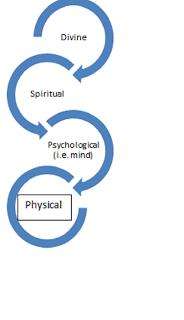

You can envisage it like this:
Or like this:
Several mystical traditions have it that the first universe to
emerge from this “Absolute”, which is referred to as the ’Divine universe’, is
beyond ordinary human comprehension. However, this Divine universe in turn
produced out of itself the ‘spiritual universe’. At the head of this spiritual
universe is the Being we can think of as the Creator God. So, to clarify, the ’Creator
God’, referred to in the first verses of Genesis, is an aspect of the original
“Absolute” and the original ‘Divine universe’.

In western Kabbalah and Gnostic Christian Kabbalah, the “Absolute”
that calls forth from itself the Divine universe is referred to as ‘Ayin En Sof’
(‘endless nothing-ness’) and in at least one version of eastern Vedanta the concept is referred to as ‘Brahman’.
The Creator God on the other hand is the ‘Keter of Beriyah’ and the ‘Tiferet of
Azilut’ (the Crown of spirituality and the Truth of the Divine’) in Kabbalah;
and as Brahma -without the final ‘n’- in Vedanta.
Those who have had direct experience of this Creator God do
report feelings of absolute bliss, peace, understanding, wisdom, compassion belonging-ness and one-ness with It in Its presence. (Not all of them are able to bring these
attributes back with them.) (In fact not all of them come back and some, who
are not sufficiently prepared, go happily mad.)
So, in answer to the original question set out above, my own
thoughts on this is that the Creator God had to work within the ‘rules’ already
set out by the ‘“Absolute” nothing-ness’ when it initiated all existence out of
itself. The Creator God could not make 2 plus 2 equal 5, for example. Similarly
it could not make an edible omelette without breaking eggs, just as you can’t
build a comfortable, civilised town without having sewers in place. Thus the
Creator God could not ‘choose’ to create a universe without what we think of as
evil and suffering.
There is also the question of balancing ‘force’ and ‘form’,
both of which are needed to make a multi- dimensional universe. On the side of
force you have: expansive tendencies, creative impulses, revelation and wisdom.
On the side of form you have: tendencies to contract and pull in, limitation
and definition (e.g. structure), contemplation of what has been revealed, and understanding.
(‘Understanding’ balances and channels ‘wisdom ‘ – this is a huge area that
I’ll return to in future blogs.)

As is the nature of any
dynamic process, these two sides, force and form, can go out of balance, even
before humankind started running around acting out of free will and often in
opposition to God’s will. As I said in my last blog, too much force and the universe
will go spiralling outwards and out of existence; too much form, and the
universe would be too uncomfortable to be lived in (possibly disappearing up
its own fundament). Between these two sides runs a ‘pillar’ holding the balance.
In this strand of creation are will, grace, compassion and truth.

So, to re-cap: The Creator God not only brought the spiritual universe into
existence out of itself (the exact process being described allegorically in the
first chapter of Genesis), it also formed, out of the spiritual universe, the
psychological universe (sometimes referred to as the astral or mental
universe), from which the spiritual universe can be accessed; and from there (the
psychological universe) made the physical universe, from which the
psychological world can be accessed. It’s what brains were made for….
So Darwin was right, but only gave part of the picture. We
are evolving back up our original involution. The brain might act as a vehicle for the mind
in evolution,
but the whole body came about as a vehicle for the mind in involution.
Every human being has a physical, psychological, spiritual
and divine aspect, because we are ultimately made out of the stuff the Divine
universe. (What a lovely thought: our
bodies are made of stardust, literally, and both our bodies and inner selves
are made of stuff that is, in its essence, Divine.) We all have immediate
access to the physical and psychological worlds on being born. We have access
to our spiritual and Divine selves by making our way up that central pillar of
truth, compassion, grace and will. We do this through meditation,
contemplation, prayer and appropriate action. [There is more about this in a later post called 'The Human Being'.]
There. I hope I’ve now put a stop to over 4,000 years of
people asking such a pesky question…
[As mentioned earlier, if this isn't clear, have a look at the posts of 28 and 29 October.]
[As mentioned earlier, if this isn't clear, have a look at the posts of 28 and 29 October.]
More on Why
In my first post on 4 Oct 2012, I said a little about why and how I got interested in mysticism in the first place, but little about why potential spiritual development has become such a priority with me now.
It's because, though I know I'm swimming against the tide in everyday society, I think IT'S THE MOST IMPORTANT THING ANYBODY CAN DO. And anybody can do it.
It's because, though I know I'm swimming against the tide in everyday society, I think IT'S THE MOST IMPORTANT THING ANYBODY CAN DO. And anybody can do it.
In the increasingly available material comforts that science
and modernism have given us, in the heady rush of “getting and spending” we “ lay waste our powers” (thanks,
Wordsworth.) Our attention is all directed outward, and we are at the mercy of
the physical world which, however pleasant we have made it, is neither designed
nor able to fulfil a good many of us. Some of us are born with, or find we have
developed, urges that the materialist world cannot satisfy.
We may throw
ourselves into our jobs, seek new relationships, engage in literature, art and
music, drown ourselves in acquisition, or in drink (my personal favourite, though
I enjoy them all); some of us will tell ourselves that there’s no point in asking
‘what’s the meaning’ because there is no meaning; and when we find ourselves
wondering if this is it, we go out and buy something, or wait until our
mood picks up. This does suit many people; probably most of the world’s
population actually, which is quite sensible once you start to look into
the perils of spiritual development. But many of us find we don’t have the
choice. It nags away at us.
More importantly, even if there isn't such an urge, nagging away at you, there is a logic in spiritual development, (I've realised I don't like the expression spiritual development - could somebody suggest something else please?) The point of the spiritual quest is to try to align yourself, your everyday ego, with the will of an entity much wiser and more compassionate.
Goodness knows the world could do with a lot more wisdom and compassion (compassion being the balancing point between 'mercy/tolerance/expansion' and 'discernment/judgement/contraction'. If there was an imbalance of too much of the first in the universe it would simply fly apart, and too much of the latter condition would make the universe unbearable to live in.)
Giving what one thinks is one's own will over to what appears to be some-one or something else is frightening in at least two ways: 1) your ego, who thinks it IS you, will fight like mad against this and 2) the spiritual quest involves rummaging around in your unconscious, and there's some very scary things in there (well, there is in mine.) Everything comes from the Absolute/Ground of all Being/Transcendent God, including evil, and there are entities out there (or, more rightly, in there) that are very unpleasant indeed. They don't always appear so, but look at what's going on around them ("By their fruits you will know them" as one great mystic said). It is necessary to affirm everyday that you are seeking the positive, the integrating, the true, the decent, the unselfish, the trusting, the hopeful and the loving.
Am I beginning to sound like a saint in my intentions??? Those who know me personally will know of course that I'm very far from it. This is all in the pursuit of self interest - what benefits the world benefits me, because I am part of that world. (I do wish some politicians would learn that.) Also, one has to take the long view. For reasons that I'll probably talk about in later posts, I believe in reincarnation, and life between lives. You can't take anything material with you from one to the other, but your mental, emotional and spiritual state will determine where you end up - like seeks to like. So it's win-win all round really.....
Monday, 8 October 2012
It's not easy being a non materialist....
In my last blog I explained how I came to be presently devoting
so much time to mysticism. But it’s not easy being a non-materialist in a
materialist world. I’m not derided for my beliefs, just mainly ignored by most
people when I’m talking about those beliefs,- even polite people who like me. (I’m relieved
to say I think some people do, i.e. like me, even some close relations.)
I think this is
because, to use my brother’s word, most people (in which he includes himself) are
just plain baffled. Often the only
language available for me to talk about my main interests in life is
unintelligible. One of the reasons I am writing this blog is to experiment with
mystical language; to find ways of expressing spiritual concepts that most
people would understand, and perhaps find useful, without actually degrading
those concepts. When teaching I had a lot of practice trying to explain some quite
high flown academic and intellectual theories and models in a way that allowed
students who were unfamiliar with such concepts to apply them immediately to
their everyday work. I don’t know if I
succeeded, but I still seem to have the urge to try, albeit in a different
realm of study.
Mystical language is obtuse, apparently, for a reason.
Although it takes a lot of work, it is possible for a human to access other
worlds with the result that such people acquire ‘unnatural’ powers in the
physical world. The use of these could cause havoc (indeed, have caused havoc.) So the teaching was
mainly oral down the centuries, and only to people who had proved themselves
stable and of good intent. When something was
written down, it was put into language which is not easily decipherable.
In addition of course, a lot of what I'm repeating in this blog would be considered heretical by many people, and in past centuries, and still in some countries, there could be dire consequences for the authors if their writings were understood by the community at large.
In addition of course, a lot of what I'm repeating in this blog would be considered heretical by many people, and in past centuries, and still in some countries, there could be dire consequences for the authors if their writings were understood by the community at large.
But I think the main reason the language is obscure is that
in modern society we just don’t have much idea of the concepts to which the
language refers, or have a rather corrupted and vague view of them. For example,
how often do you think of angels (the non-human ones) and in what context? What
is your Soul, and how does if differ from the metaphorical way in which we use
the word ‘heart’ (e.g. “her heart wasn’t in it any more”)? What is the relationship
between your ego/superego, your Higher Self and your Soul, and how do you
benefit from knowing? When I assure you that both you and me are ‘God’ do you
want to run screaming from the room, or are you reassured? If I mention that your Soul doesn't take much interest in you until you show some interest in it, do you have any idea what I'm talking about?
Modernism, which we tend to date back to the Enlightenment
at the end of the 18th century, is wonderful. Its rationality has
freed us from life-draining superstition and all sorts of unfair and unjust
practices previously maintained as ‘tradition’. But in throwing out the bath
water of superstition and religion, (many religions having drawn far away from the impulses
which created them), we threw out the baby of access to our interior selves. The
precise meaning of words like ‘heaven’ ‘paradise’ ‘soul’ ‘divine’ ‘prayer’ ’spirit’ are as baffling
to most people nowadays as are the words used in quantum mechanics to most non-scientists. I suppose the majority of people think that understanding the concepts involved in either
area is irrelevant to their everyday lives. Tomorrow or Thursday I intend to
blog about that in more detail. In the meantime, I’d be very interested in
others’ views.
Friday, 5 October 2012
So What Now?
Yesterday I wrote about the mundane way in which my interest
in spirituality may have been generated. That was only a quick sketch of course
and I will, at some later date, come back to various aspects of it, so that
others might share their own experiences as well.
Today, I hope to describe how I’ve reached my present point,
where I am now spending several hours a day not only reading up on and
memorising everything I can find on Gnostic Christianity and Kabbalah, but also
contemplating those readings, meditating, praying and carrying out various
spiritual exercises. What am I hoping to achieve? And why is it happening now?
At a practical level, I have the time to do this because I
am unemployed. I am not seeking work because firstly, my unemployment was the
result of voluntary redundancy, and the subsequent redundancy payment is large
enough, if I’m careful, to live on until I can claim my pension. Secondly, I am suffering quite badly now from fibromyalgia, and would not at the moment
make a reliable employee.
I have no mortgage,
because 12 years ago I decided to downsize from a huge detached four-bedroomed
house to a two-bedroomed cottage. I have no expensive hobbies, my life revolves
around books, the internet, the TV, visits to and from friends and long outings
to coffee houses with my husband to talk (we sometimes forget to do so at
home.) My surroundings are becoming shabby, but not unliveable in nor yet unaesthetic or displeasing.
That’s one way of looking at it. I have constructed another
perspective; that in the light of what my studies have taught me, makes
considerably more sense.
After a varied career, I became a lecturer in organisational
management in a university, a job I loved. A few years back however, the job
began to pall, and it was also at that time that my fibromyalgia attacks (involving
pain, depression and chronic fatigue) began to become more frequent. I think these
two changes were ascribable to a number of reasons. I continued to enjoy the
teaching - most of my students were postgraduate and working fulltime, and
taught me as much, if not more, than I taught them- and I enjoyed doing
research. I had some lovely colleagues.
But I was disillusioned with where this country was going with higher
education, and at odds with various aspects of the culture that my own
institution had developed. Although now happily married, I kept finding myself
dreaming of the life of a contemplative nun! (Perhaps one who was allowed home to her husband in the evenings an weekends.) The 20 minute walk to the station
at the beginning of each day’s commute became increasingly difficult, and it
was taking me longer to recover from each of the three hour lectures I gave. My
own prime intellectual interest had shifted back from organisational psychology
to mysticism, and I kept trying to introduce this into my own Doctoral level
research on management in organisations, which really annoyed at least one of
my supervisors, a committed Marxist materialist. (I’m using the word ‘materialist’
here to describe some-one who believes that nothing exists beyond the material
world).
I began to feel restless, but it never occurred to me to give up or
change my job. I couldn’t think of anything else that I wanted to do, other
than pursue my mystical studies, and it never occurred to me to give up work
voluntarily – that would have seemed too irresponsible. But I remember saying
to my son one morning that I needed more help with the housework, or I wasn’t
going to make it through the last few years that I had before retirement.
And then the University abolished my post. Over fifty posts
were abolished and replaced with 29 new ones, for which the displaced post-holders
were invited to apply. I went to bed one Tuesday night wondering how best to
present myself to get one of those new jobs, and woke up the following morning
knowing it was time to walk. I cannot tell you how overjoyed I was at this
decision, even before I had calculated what redundancy money I would get. The
prayers I didn’t know I’d been praying were answered, I think, because not only
had my need become so great, but because the change suited the purposes of my
soul. Kabbalah and Gnostic Christianity (well, most schools of mysticism) would
say that my interest in the spiritual had sparked the interest in turn of
Providence in me. Working from a place where time and cause and effect operate
differently, the money to leave turned up as and when needed. Any earlier, and
I wouldn’t have dared take the opportunity. Any later, and I would have been too
ill, and perhaps already left.
Materialists can point to happy but meaningless coincidences
if they wish, but this has happened to me one too many times too often now for
me to be that glib about it. Again, this is something I might write about in
future blogs, and I would be interested in others’ experiences.
Thursday, 4 October 2012
Why?
I’m really not clear why, or how, my interest in the
existence of unseen worlds beyond the one I live in everyday came about, but it
is reassuring that there are so many others like me. Most of us, when
introducing ourselves to a physical or virtual group of fellow seekers simply
say something like: “I have always been interested in/drawn to/ aware of spiritual
matters”.
In my own case I suspect that it was the often painful
difficulties of everyday life, interspersed with long periods of the simple
dullness and monotony of the daily round that sparked my interest in anything
‘other,’ from the possibility of extra-terrestrial life, through magic, extra-sensory
perception, ghosts, fairies and mysterious ancient religions. I didn’t put
modern day religions into this ‘exciting’ category – I could see nothing
mysterious at all in most of them. Maybe Christianity, present nearly every day
at school or Sunday school, was just too much part of the mundane world I was
trying to escape because, looking at it now, there isn’t anything much more
mysterious than getting born to a virgin, and resurrecting from death in the
flesh. Perhaps that stretched even my own credulity too far.
In my teens, my interest in all matters ‘other’ led me to an
interest in psychology, and to Jung. Jung’s writings led to an interest in
mysticism, and the possibility of enlightenment, i.e. fulfilling one’s ultimate
potential as a human being. As an unsuccessful over-achiever (having a good
part of what many psychotherapeutic
disciplines would call a ‘striver’ mentality in the make-up of my
personality) I found this quite irresistible. To my great delight, I found that
most schools of mysticism had underlying cosmologies that were considerably
more detailed, logical and interesting than could be found in the opening
chapters of the bible or in cosmological science. Starting with Gurdjieff, whose
work can be linked to the esoteric school of Islam, i.e. Sufism, I went on to
find out as much as I could about (among others) Vedanta, Plotinus, Plato, Zen
Buddhism, Shamanism, the Tao, the Western mystery traditions, Kabbalah and,
finally, Christian mysticism.
My most profound discovery was how similar are the practices
and belief systems of all these different schools. However, the symbolism of each is
rooted in a particular culture, and therefore symbolism varies from school to
school. I think that I might be getting the most from Gnostic Christian
Kabbalah because the symbols were rooted in my consciousness at a very early
age.
But despite my interest and my considerable reading on the
subject, taking it any further has been difficult. I have consciously made increasing
efforts (not always successful) to live according to the golden rule of most
traditions – be kind to all other creatures, but the demands of work, child-rearing,
keeping house, and coping with myriad non-fatal but considerably debilitating
illnesses have been paramount. My personality’s need for worldly success, a
certain degree of power (more about that in later blogs) and a level of
material comfort and aestheticism combined to keep my spiritual aspirations in
the background – an intellectual hobby, rather than a way of life.
This has all recently changed, and that is what has prompted
this daily blog – the desire to make contact with others in the same position
as myself. Please join me, with your responses.
Subscribe to:
Posts (Atom)